The Capercaillie Complex
The one rare bird I will happily never see again

I went for a peaceful walk in the Abernethy Forest the other day. That was the plan, anyway. A gentle wander among the pines, a bit of birdsong, maybe I’d even spot a crested tit for the first time. It would be the kind of wholesome Highlands experience that makes you feel like a Victorian naturalist, minus the alarming amount of tweed.
And technically, that is what happened. I did see something rare and majestic.
Unfortunately, it also tried to kill me, or if not kill me exactly, then at the very least maim to the extent of a hospital visit by drawing blood.
The culprit was a capercaillie - a bird that looks like someone crossed a turkey with a small velociraptor and then gave it a personality based entirely on rage. They are one of Britain’s rarest birds, a conservation success story in the making, and a creature that I am now delighted to admire exclusively from a very great distance.

The encounter began innocently enough. I was walking along a forest track (I can’t divulge exactly where because hoards of twitchers will go) enjoying the quiet, trying to take in the beauty and not think about the edits of my next book - sunlight filtering through the trees, the early signs of spring - when I heard a loud clicking sound, an odd sound I’d never heard before, coming from somewhere above my right ear.
Looking up I noticed a very large, dark bird perched on the branch of a Scots Pine, no more that two meters from my head.
Now, had I (luckily) not got talking to a cross-country skier in January, when I was last on the same trail, and heard his own terrifying account of an encounter with a capercaillie, I would have thought, ‘How lucky. An actual capercaillie! They are not the avian version of the elusive haggis after all!’
What I thought instead was: Balls, a Capercaillie. Why is it this thing staring at me like I owe it money?
Unfortunately I made eye contact, which led to the clicking sound becoming more intense. The tail feathers, already on full display, puffed up further, and it lowered its head and wings slightly in what I later learned was this capercaillie’s equivalent of rolling up it’s sleeves.
What followed was a brief but memorable skirmish in which a creature the size of an overconfident chicken swooped down at me with the determination of a medieval cavalry unit. Now, these birds are not graceful in the air, and what I witnessed as it launched itself off its perch and headed directly for my head was more of a controlled crash than graceful flying. But even so, it had the honing capability of an Exocet. There was flapping. There was hopping. And there was an alarming amount of shouting, mostly from me.

Yes, I was carrying a walking stick and could have whacked it one, but not only is this a protected species, but I honestly don’t think any amount of smacking with a stick would stop the tirade. It’s the type of creature that happily will lose a limb, Monty Python style, and brush it off as a mere scratch and keep on fighting.
And these things can run!
With my dignity somewhat compromised but limbs largely intact, I retreated (aka legged it while it kept pecking at my heels). Once the clicking noise subsided and I was at a distance that must surely be safe, I looked back down the track, only to see that the dark menace was still standing there. He started shouting the capercaillie equivalent of, ‘… and the horse you rode in on, arsehole!’ in my direction.
Now, in fairness to the bird, capercaillie are famously territorial, especially during the breeding season (this was a month earlier than advertised but it was a sunny day so he was perhaps a little confused) when the males are full of hormones and extremely convinced of their own importance. From the bird’s perspective I was just another large mammal blundering through its front garden. I have long avoided a stretch of the same path where locals such as myself know that one particularly aggressive capercaillie (who has been given a nickname of something like Dangerous Duncan) has dominance. Where I encountered the bird however was in a different place altogether, a place I had long though of as ‘safe’.
Not anymore.
Their behaviour, I’m told, is fairly typical for animals experiencing what scientists politely call ‘overly high testosterone levels’. It’s a pattern seen throughout the animal kingdom: puffing up, loud displays, aggressive posturing, and a complete inability to de-escalate once the performance has begun…
Watching that capercaillie strut, shout, and charge anything that moves does bear an uncanny resemblance to recent moments in international politics. The bird’s absolute certainty that it must dominate the situation immediately, regardless of whether the target is a rival male, a hiker, or presumably a small forestry vehicle, seems to blind him to the fact that it’s all so unnecessary: Lots of display, lots of noise, very little sense that backing down might occasionally be the wiser move.
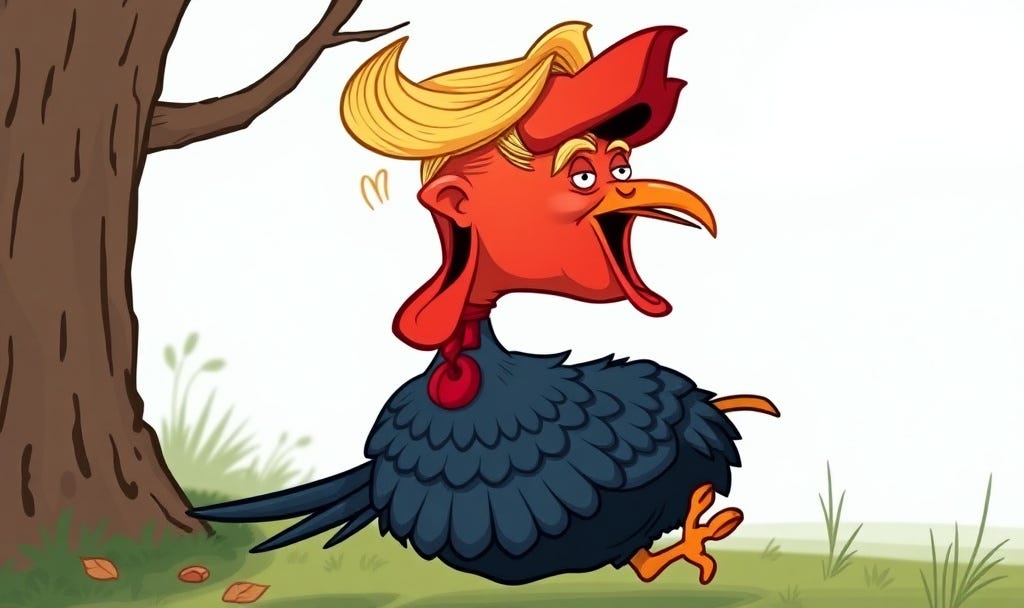
Capercaillie, however, have one important advantage: they actually belong in the forest.
And that, in the end, is what makes the whole episode oddly reassuring, that there are still places where nature remains firmly in charge. In the Abernethy Forest, if a capercaillie decides a trail is closed, then that trail is closed. Not by committee, not by signage, but by the rule of a furious prehistoric grouse with something to prove.
It’s hard to argue with that kind of authority.
So yes, I’m grateful to have seen one of Britain’s rarest birds in the wild. It was memorable. It was educational. It was mildly terrifying.
And if I never see another one at close range again, I will consider that an entirely satisfactory outcome.
Oh my goodness, this is so brilliantly funny and scary at the same time. Very Monty Python. Maybe he was Dangerous Duncan’s cousin?